
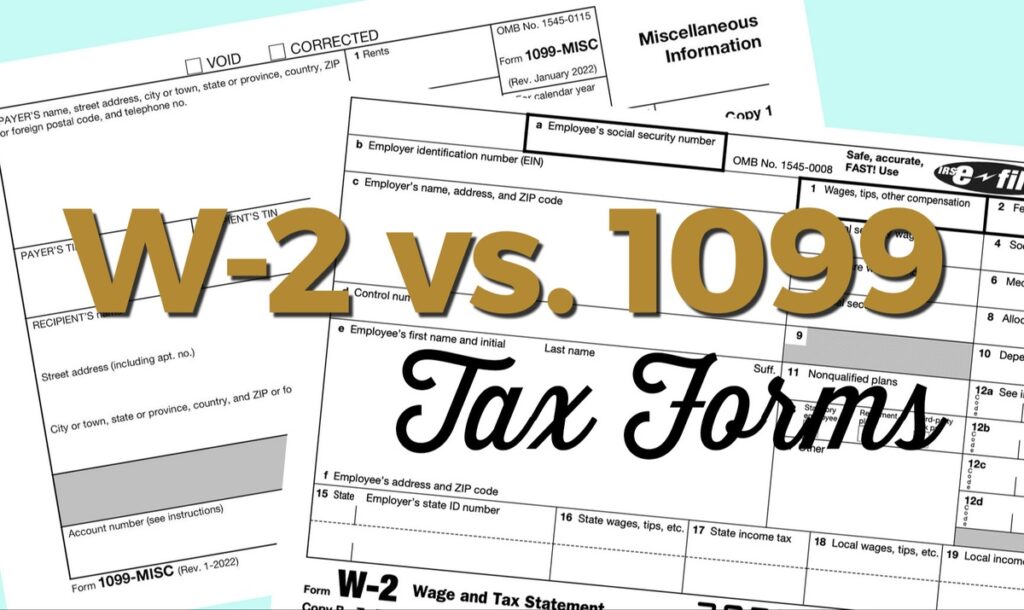
Understanding the difference between 1099 vs W-2 workers is essential for business owners, freelancers, and employees alike. Whether you’re hiring help, working as an independent contractor, or managing payroll for a growing company, knowing which tax form applies to you can prevent costly IRS mistakes and penalties.
Misclassifying workers is one of the most common tax compliance issues businesses face today. The IRS closely monitors how companies classify workers, and getting it wrong can lead to back taxes, fines, and legal trouble. In this guide, we’ll break down the key differences between 1099 independent contractors and W-2 employees, explain tax obligations for each, and help you determine which classification applies to your situation.
What Is a W-2 Employee?
A W-2 employee is someone who works under the direct control of an employer. If you receive a W-2 form at the end of the year, you are considered an employee, not self-employed.
Key Characteristics of W-2 Employees
- The employer controls how, when, and where work is performed
- Taxes are withheld automatically from each paycheck
- Employees may receive benefits such as health insurance, paid time off, or retirement plans
- The employer issues Form W-2 by January 31 each year
Tax Responsibilities for W-2 Employees
For W-2 employees, taxes are relatively straightforward. Employers withhold:
- Federal income tax
- Social Security tax
- Medicare tax
- State and local taxes (if applicable)
At tax time, employees use their W-2 form to file their income tax return. The employer also submits copies of W-2 forms to the IRS and Social Security Administration.
What Is a 1099 Independent Contractor?
A 1099 worker, also known as an independent contractor or freelancer, operates as a self-employed individual. Instead of receiving a W-2, contractors receive Form 1099-NEC if they earn $600 or more from a business during the tax year.
Key Characteristics of 1099 Contractors
- They control how the work is done
- They often work with multiple clients
- No taxes are withheld from payments
- Contractors are responsible for their own tax payments
Tax Responsibilities for 1099 Workers
Independent contractors must:
- Pay self-employment tax (15.3%)
- Make quarterly estimated tax payments
- Track income and expenses
- File Schedule C and Schedule SE with their tax return
Because no taxes are withheld upfront, proper recordkeeping is critical for 1099 workers.
1099 vs W-2: Side-by-Side Comparison
| Feature | W-2 Employee | 1099 Contractor |
|---|---|---|
| Employment Status | Employee | Self-employed |
| Tax Withholding | Employer withholds | No withholding |
| Benefits | Often provided | Not provided |
| Tax Form Issued | W-2 | 1099-NEC |
| Work Control | Employer | Contractor |
| Tax Filing Complexity | Lower | Higher |
Understanding these differences helps both businesses and workers stay compliant.
How the IRS Determines Worker Classification
The IRS does not allow businesses to choose worker classification arbitrarily. Instead, it uses a three-factor test to determine whether a worker is an employee or independent contractor.
1. Behavioral Control
Does the business control how the work is performed?
- Training requirements
- Instructions on how to do the job
- Specific working hours
More control typically indicates a W-2 employee.
2. Financial Control
Who controls the financial aspects of the job?
- Who provides tools and equipment?
- Is the worker paid hourly or per project?
- Can the worker incur a loss?
Independent contractors usually have more financial independence.
3. Relationship of the Parties
- Is there a written contract?
- Are benefits offered?
- Is the relationship ongoing or project-based?
Long-term, benefit-based relationships point toward employee status.
Common Misclassification Mistakes Businesses Make
Worker misclassification is often unintentional but still costly. Common errors include:
- Paying workers as contractors to avoid payroll taxes
- Issuing a 1099 to someone who works full-time under supervision
- Misunderstanding state-specific labor laws
- Ignoring IRS classification guidelines
The IRS can reclassify workers retroactively, leading to penalties, back taxes, and interest.
Penalties for Misclassifying Workers
If the IRS determines a worker was misclassified, businesses may face:
- Back payment of payroll taxes
- Penalties for failure to withhold taxes
- Interest on unpaid taxes
- Additional fines for intentional misclassification
Correct classification from the start is always cheaper than fixing errors later.
Which One Applies to You?
If You’re a Worker
You are likely a W-2 employee if:
- You work set hours
- Your employer directs your tasks
- You receive benefits
You are likely a 1099 contractor if:
- You invoice clients
- You set your own schedule
- You pay your own taxes
If You’re a Business Owner
You should classify workers as:
- W-2 employees if you control their work and schedule
- 1099 contractors if they operate independently and offer services to others
When in doubt, consult IRS guidelines or a tax professional.
How PhcWorkHub Helps Businesses Stay Compliant
At PhcWorkHub, we understand how confusing worker classification and tax forms can be. That’s why we provide digital tools that help businesses and freelancers:
- Generate accurate tax documents
- Track income and payments
- Maintain proper records for audits
- Stay compliant with IRS deadlines
Using reliable payroll and documentation tools reduces errors and saves time during tax season.
Final Thoughts: Get Classification Right from Day One
Understanding the difference between 1099 vs W-2 workers is critical for staying compliant and avoiding unnecessary stress. Whether you’re hiring your first worker or managing multiple contractors, proper classification protects both your business and your workers.
When you stay informed, keep good records, and use the right tools, tax compliance becomes much simpler. PhcWorkHub is here to help you navigate worker classification, payroll documentation, and tax preparation with confidence.